Last Updated on March 30, 2026
Contents
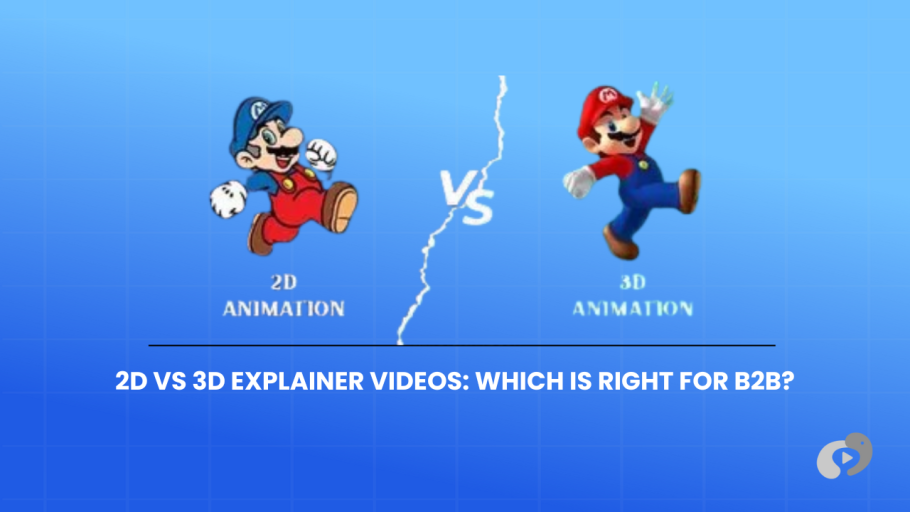
Choosing between 2D vs 3D explainer videos is the debate that happens in almost every single discovery call I have. The marketing team sits on one side of the Zoom screen, and the founder sits on the other. Typically, one of them wants a clean, simple 2D animation that explains the software clearly. Conversely, the other wants a high-end 3D video that looks like a Super Bowl commercial for a luxury car.
Ultimately, they look at us waiting for a tie-breaker.
As a strategic explainer video agency, I understand the conflict. You want your brand to look premium. Naturally, you see the market standards set by Apple or Microsoft and want to match that perceived quality. However, production realities and budget constraints require a strategic approach, especially when the product might just be a spreadsheet interface in the cloud.
The Design Dilemma: 2D vs 3D Explainer Videos
Choosing the right animation style is not just an aesthetic choice. In reality, it is a strategic business decision. 3D animation, often referred to as CGI, offers a level of depth that 2D cannot achieve.
The Brand Signal
The style you choose sends a subconscious signal to your buyer. For instance, 2D signals ease-of-use and agility. On the other hand, 3D signals robustness, infrastructure, and enterprise-grade capability.
The Goal of This Comparison
I want to settle this debate once and for all. Or at least I want to give you the framework to make the right choice for your specific product. We aren’t going to talk about polygons or vector points here. Instead, we are going to talk about conversion, trust, and B2B video production realities.
TL;DR: The Verdict at a Glance
Choose 2D Animation If:
- You are a SaaS or Fintech company selling an “invisible” solution like data or security.
- You need to depict relatable user scenarios that validate specific professional pain points.
- You need flexibility to update the UI screens later as your software evolves.
- You are working with a standard marketing budget and a tight 4-6 week timeline.
Choose 3D Animation If:
- You sell physical hardware, robotics, or complex machinery that needs to be seen from all angles.
- You are in “Deep Tech” or Cyber Security and want to visualize abstract networks in a cinematic way.
- Your brand archetype is “The Ruler” or “The Visionary” and you need to signal high value status.
- You have a higher budget and a longer timeline (8-10 weeks) to allow for rendering.
1. Defining the Contenders for 2D vs 3D Explainer Videos
Before we fight, let’s clarify what we are actually talking about. When comparing 2D vs 3D explainer videos, definitions matter. When I say 2D, I don’t mean cartoons for kids. Similarly, when I say 3D, I don’t necessarily mean Pixar. In the B2B world, these styles have specific functions.
The Case for 2D (Motion Graphics)
This is the workhorse of the B2B industry. It is flat. Specifically, it uses shapes, icons, typography, and sometimes characters. Think of it like a digital illustration that moves.
It is incredibly versatile. We can make it look hand-drawn and organic, or we can make it look sharp and corporate.
Because it is abstract, it is perfect for explaining things that don’t have a physical form. If you are selling a “workflow automation tool,” you can’t film it. But in 2D Animation, we can draw a line connecting a person to a server to a bank. Essentially, it simplifies the complex.
The Case for 3D (CGI)
This creates an environment with depth. You can rotate the camera around an object. Additionally, it has lighting, texture, and shadows. It feels real.
In B2B video production, this is often used for “Hyper-realism.” We might create a glass server room or a metallic robot arm. It looks expensive because it is expensive. Crucially, it tells the viewer that you have invested heavily in your image.
2. Why SaaS and Fintech Usually Love 2D
If you look at the heavy hitters in SaaS companies like Slack, HubSpot, or Dropbox, you will see a lot of 2D animation. 2D animation relies on vector graphics, which allows for infinite scalability without quality loss.
Why is that?
It is not because they are cheap. They have massive budgets. Rather, it is because 2D is better at abstraction.
The “UI Problem”
Most B2B software looks boring. I’m sorry, but it is true. It is just rows of data and buttons. If you render a spreadsheet in hyper-realistic 3D, it just looks like a weirdly dramatic spreadsheet. Simply put, it feels out of place.
But in 2D, we can create a “Simplified UI.” We can strip away the clutter, make the buttons glow, and make the data fly out of the screen. In short, 2D allows us to lie a little bit. We can represent the idea of the software rather than the literal reality of it.
The Trust Factor in Fintech
In Fintech, you are dealing with people’s money. There is a psychology here. If your video looks too “sci-fi” or too dark and moody (which 3D often is), it can feel intimidating.
Conversely, 2D animation, especially with clean vectors and bright colors, feels transparent. It feels safe. It says, “We have nothing to hide.” I think this is why so many neobanks use that flat, colorful illustration style. They are trying to look like a friendly alternative to the scary old banks.
3. When 3D is the Only Option (Hardware and Deep Tech)
On the flip side, there are industries where 2D just falls flat. If you are manufacturing a new type of EV battery or a drone for agricultural monitoring, 2D won’t cut it. Your clients need to see the product. Specifically, they need to see the build quality. We use 3D to simulate realistic depth perception, making your product look tangible on screen.
Visualizing the Internal
One of the superpowers of 3D Animation is the “Exploded View.” We can take your machine and pull it apart in mid-air. For example, we can show the internal cooling system or the gear mechanism.
You cannot do this with live video production (unless you destroy your prototype). Furthermore, you cannot really do it in 2D without it looking like a blueprint. 3D gives you X-ray vision.
The “Cyber” Aesthetic
There is a specific niche in B2B, especially in Cybersecurity and AI, where 3D has become the standard. Why? Because they are selling protection. A 3D shield made of glowing glass looks stronger than a 2D shield drawn with a marker.
3D allows us to use materials like metal, carbon fiber, and light. These materials communicate strength and durability. If you are selling an enterprise firewall, you want it to look impenetrable.
4. The Budget Reality Check for Cost of 2D vs 3D Explainer Videos
We have to talk about money. As we discussed in our Pricing Guide, there is a significant price difference between these two animation styles.
The Cost of Dimension
3D is almost always more expensive. Why? It comes down to the labor. In 2D, if I want to draw a chair, I just draw a chair. In contrast, in 3D I have to model the chair, texture the chair (is it wood? leather?), light the chair (where is the sun?), and then position the camera. And then I have to render it.
The Rendering Tax
Rendering is the computer processing time required to generate the final image. For a complex 3D scene, it might take hours to render a single second of video. Consequently, this requires expensive hardware or rental of “render farms.” All of that cost gets passed on to you.
My Advice:
If you have a strict budget of $10,000 or less, stick to 2D. You will get a world-class 2D video for that price. However, if you try to do 3D for that price, you will end up with something that looks like a video game from 1998. The reality is: Bad 3D looks much worse than average 2D.
5. Timeline and Agility in 2D vs 3D Animation
Speed is often a deciding factor for our clients. You have a product launch in four weeks. Which style should you choose?
Go with 2D.
The Iteration Cycle
In 2D, if you don’t like the color of the character’s shirt, we can change it in five minutes. Conversely, in 3D, if you don’t like the texture of the object, we might have to re-texture, re-light, and re-render the whole scene.
Therefore, the feedback loop in 3D is slow.
This matters in the Agile B2B world. Your product team might change a feature halfway through production. In a 2D workflow, we can adapt. However, in a 3D workflow, a major change mid-production can derail the timeline by weeks.
This ties back to our Production Process guide. Ideally, the pre-production phase for 3D has to be much more rigid. Once we leave the storyboard phase in 3D, there is no turning back without significant cost.
6. Future Proofing Your Assets
Here is a point that most people don’t think about until a year later. B2B products evolve. You ship new features. You change your logo. You update your UI.
The Maintenance Cost
Updating a 2D video is relatively easy. We open the project file, swap the screenshot, and re-export. On the other hand, updating a 3D video is hard. We have to make sure we still have the same software versions, the same plugins, and the same render settings.
Worse yet, if the 3D artist who made the original video has left the agency, it can sometimes be impossible to recreate the exact same look for an update. So, if you are a startup and your product is changing every month, sticking to 2D is the safer choice in the 2D vs 3D explainer videos decision.
7. The Hybrid Approach: “2.5D”
There is a middle ground that I honestly love. We call it 2.5D. This is where we take 2D assets (like flat illustrations) and place them in a 3D space. Imagine paper cutouts standing up on a table. You get the depth and the dynamic camera moves of 3D, but you keep the clean simple aesthetic of 2D.
Why It Works for B2B
It feels modern. In fact, it stands out in a LinkedIn feed because it looks different from the standard flat animated explainer video content. It is also cost-effective. Ideally, it is cheaper than full 3D but looks more premium than standard 2D. We use this a lot for SaaS and Fintech clients who want to “level up” their brand without blowing the budget.
8. Matching Style to Brand Archetype
Sometimes the decision isn’t about the product. Instead, it is about the soul of the company. I like to ask clients: “If your brand was a person, who would it be?”
The Everyman / The Helper
- Style: 2D Character Animation.
- Vibe: Warm, relatable, imperfect.
- Best For: HR platforms, SMB tools, Healthcare.
- Goal: The goal is to show empathy. You want the viewer to see themselves in the video.
The Magician / The Sage
- Style: Abstract Motion Graphics (2D or 3D).
- Vibe: Smart, fluid, data-driven.
- Best For: AI platforms, Analytics tools, Logistics.
- Goal: The goal is to show intelligence. You are making the complex simple.
The Ruler / The Hero
- Style: High-End 3D Cinematic.
- Vibe: Dominant, powerful, flawless.
- Best For: Enterprise Security, Defense, Premium Hardware.
- Goal: The goal is to dominate. You want to intimidate the competition.
9. The Integration Factor
Where is this video going to live?
On the Website
If your website is super minimal and uses flat design, a heavy 3D video might clash. Ultimately, it might feel like it belongs on a different site. You want the video to feel like a window into your brand, not a separate entity.
In the Slide Deck
If your sales team uses PowerPoint presentations, 2D animation clips often integrate better. Typically, they are lighter files and match the graphic style of most slide decks.
On Social Media
Here is where 3D shines. Social media is noisy. A spinning 3D logo or a gravity-defying product animation stops the scroll. Because the human eye is attracted to depth, 3D creative often has a higher click-through rate if you are running paid ads.
10. The Talent Gap
There is one more reality I have to share. Good 2D animators are easier to find. However, good 3D animators are rare and expensive.
If you hire a “budget” agency to do 3D, you are taking a massive risk. Bad 2D just looks a bit boring. But low-quality 3D damages brand credibility. If the lighting or physics are incorrect, the result looks amateurish and suggests a lack of attention to detail.
Therefore, if you cannot afford top-tier 3D talent, it is always better to choose top-tier 2D talent. A great 2D video beats a mediocre 3D video every single time.
Final Analysis
So who wins the 2D vs 3D explainer videos battle? There is no winner. Truly, there is only the right tool for the job.
I generally recommend 2D Animation if:
- You are selling software or services.
- Your story is about people and relationships.
- You need flexibility and speed.
I recommend 3D Animation if:
- You are selling hardware or physical products.
- Your story is about strength, protection, or infrastructure.
- You need to signal premium status and have the budget to back it up.
Don’t let your personal taste dictate the decision. Just because you think 3D looks “premium” doesn’t mean it will sell your HR software. And just because 2D is “cheaper” doesn’t mean it is the right choice for your luxury robotics brand.
Listen to your product. Listen to your audience. Eventually, the right style will make itself obvious.
And if you are still stuck? That is what we are here for. We can do both. Specifically, we can show you a style frame in 2D and a style frame in 3D and let you see the difference with your own eyes. Sometimes you just have to see it to believe it.