
Last Updated on March 9, 2026
Contents
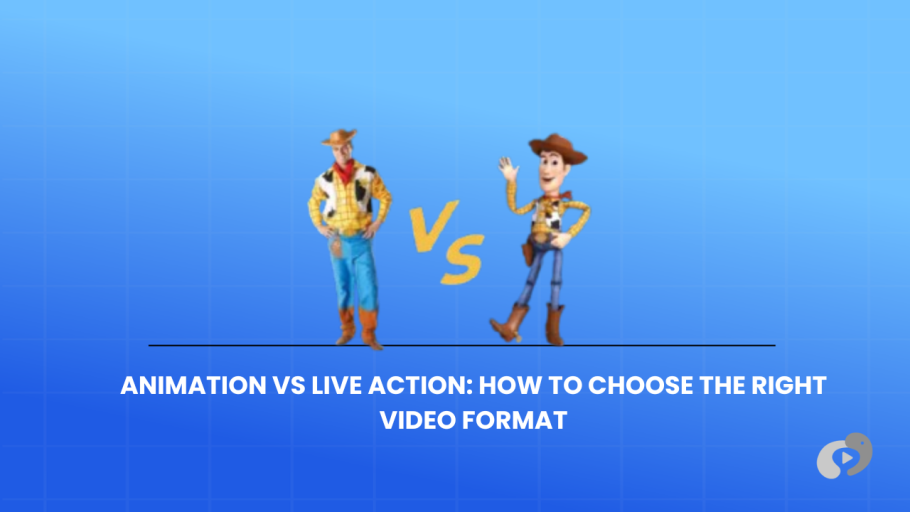
Animation vs live action is one of the most common questions marketers face when planning a video project. Both formats work. Both have clear strengths. But choosing the wrong one wastes budget and reduces results.
This guide breaks down the core differences between animation and live action video. It shows where each format wins, compares realistic costs, and gives you a four-question framework to make the right call for your brand in 2026. Whether you work in SaaS, healthcare, manufacturing, or e-commerce, you will find a specific recommendation for your industry below.
TL;DR
Here is how to decide between animation and live action for your next video.
- Core difference: Live action uses real cameras and people. Animation builds everything from scratch and gives you unlimited creative control.
- When animation wins: Abstract products, complex workflows, global audiences, evergreen content, and situations where you cannot film on location.
- When live action wins: Physical products, emotional brand storytelling, recruitment videos, and premium brand positioning where human faces build trust.
- Industry guidance: SaaS and healthcare lean toward animation. E-commerce and professional services often get stronger results from live action.
- Hybrid is often best: Combining live action and animation gives you human credibility and visual explanation power in one video.
What Is the Core Difference Between Animation and Live Action?
The difference comes down to production method and creative flexibility.
Live action uses real cameras, real people, and real locations. You film what exists in the physical world. The result feels familiar, human, and credible. Audiences trust faces.
Animation builds everything from scratch. Characters, environments, and motion are created digitally or by hand. Nothing needs to exist in the real world. That gives animation unlimited creative range.
Both formats tell compelling stories. The decision depends on your message, your audience, your budget, and your timeline.
Where Animation Wins
Animation dominates in certain situations. Here are the cases where it is clearly the better choice.
Explaining Abstract or Complex Ideas
Software products, financial services, and technical processes are hard to show with a camera. Animation lets you visualize data flows, SaaS dashboards, molecular structures, and invisible mechanisms. You can show what a camera cannot capture.
According to Think with Google video, video that simplifies complex information drives stronger purchase intent. Animation is the fastest path to simplifying complexity.
Full Brand Control
Every color, shape, character, and motion in an animated video is on brand. There are no bad lighting days, no talent who looks slightly off, and no locations that feel wrong. If your brand guidelines are strict, animation gives you total visual control.
Evergreen Content That Lasts
Live action ages quickly. Hairstyles change. Offices get redecorated. Faces on screen leave the company. Animation stays fresh indefinitely. You can update a few scenes without reshooting the whole video.
Lower Long-Term Cost for Multiple Versions
Creating multiple language versions, regional cuts, or updated messaging is straightforward with animation. You swap the voiceover or adjust on-screen text. With live action, a script change often means a full reshoot.
No Casting or Location Logistics
There are no actors to schedule, no studios to book, and no weather to worry about. Animation production runs on a predictable timeline without the logistical risks of a live shoot.
You can see how leading brands use animation in our breakdowns of SaaS explainer video examples and AI explainer video examples.
Where Live Action Wins
Live action is the right choice in specific contexts. Do not default to animation when live action would serve you better.
Building Human Trust and Emotional Connection
A real face creates trust faster than an illustrated character. Customer testimonials, CEO messages, case study videos, and brand stories work better when real people appear on screen. Audiences connect emotionally with humans in a way they rarely do with animated characters.
Physical Products
If you sell a physical product, showing it in real hands in real environments drives conversions. A camera captures texture, scale, and practical use in ways animation rarely matches. E-commerce brands consistently see stronger results with live product footage. Statista’s online video data shows video viewing continues to grow year over year across every major market.
High-End Brand Positioning
Premium brands in luxury goods, professional services, and consulting often use live action to signal quality and seriousness. A well-shot live action piece communicates investment and credibility without saying a word.
Corporate Culture and Recruitment
Showing a real office, real employees, and authentic company culture requires real footage. Candidates and clients want to see the actual environment. Animation cannot substitute for genuine behind-the-scenes content.
Emotional Storytelling and Brand Narrative
Narrative-driven content with real actors, real emotion, and real moments tends to perform strongly on social platforms. Nielsen consumer insights consistently shows that emotional content drives higher recall and brand preference.
Animation vs Live Action: Investment Comparison
Budget is often the deciding factor. Here is a general investment comparison for animation vs live action video in 2026.
| Format | Entry Level | Mid Range | Premium |
|---|---|---|---|
| 2D Animation | Lower range | Mid range | Higher range |
| 3D Animation | Mid range | Higher range | Premium |
| Motion Graphics | Lower range | Mid range | Higher range |
| Live Action (basic) | Lower range | Mid range | Higher range |
| Live Action (corporate) | Mid range | Higher range | Premium |
| Hybrid (mixed format) | Mid range | Higher range | Premium |
Live action costs can spike unpredictably. Travel, location fees, talent fees, and reshoots add up fast. Animation costs are more predictable because most work happens in post-production with a fixed team.
For a full breakdown of what affects production pricing, read our cost breakdown.
Animation vs Live Action: Industry-Specific Recommendations
The right format varies by industry. Here are specific recommendations for five key sectors.
SaaS and Software
Use animation. SaaS products live on screens. The value proposition involves invisible logic and abstract workflows. Animation lets you show dashboards in motion, data connections, and user journeys without the limitations of screen recording. Animated explainer videos convert better on SaaS landing pages because they simplify complex software value in 60 to 90 seconds.
Healthcare and Medical
Use a hybrid approach. Medical accuracy matters above all else. Animation excels at showing internal body processes, surgical techniques, and drug mechanisms that cameras cannot capture. Live action works for patient testimonials, hospital culture content, and staff introductions. Combining both formats builds trust while explaining complex science clearly.
Our healthcare examples covers this in depth.
Manufacturing and Industrial
Use both formats, depending on purpose. For training videos and safety procedures, animation simplifies dangerous or inaccessible processes without putting anyone at risk. For client presentations and sales materials, live action footage of real machinery and real facilities builds credibility. A hybrid approach often works best for manufacturers.
E-Commerce and Consumer Products
Use live action as the primary format. Shoppers want to see real products in real hands in real environments. Lifestyle footage drives purchase decisions more effectively than illustrated representations. Use short animations to explain features or add visual interest to product demos, but ground your content in authentic footage.
Professional Services
Use live action. Law firms, consultancies, accounting practices, and financial advisors earn trust through people, credentials, and track records. Real faces, real offices, and real client testimonials signal credibility that animation cannot replicate. Animation can supplement explanations of complex processes, but the primary content should feature real people.
Animation vs Live Action Cost and Decision Framework
Answer these four questions to determine the right format for your next video project.
Question 1: Is your product or service tangible?
If yes, live action is likely better. Shoppers and clients want to see the real thing. If no, animation is likely better because there is nothing physical to film.
Question 2: Does your message require visualizing something invisible or abstract?
If yes, animation is almost always the right choice. Processes, software, data, science, and financial concepts all benefit enormously from animation.
Question 3: Is this content meant to last more than two years without major updates?
If yes, animation reduces long-term costs and stays evergreen. If the content will change frequently, weigh whether live action reshoots are manageable within your budget.
Question 4: Is the primary goal to build personal trust or emotional connection?
If yes, live action with real people performs better. Trust transfers faster from human faces than from illustrated characters.
If your answers point in different directions, a hybrid approach (described in the next section) usually resolves the tension without sacrificing either goal.
Mixed Live Action and Animation: The Hybrid Approach
Hybrid videos combine live action footage with animated elements. This format is growing in popularity because it captures the strengths of both approaches.
Common hybrid combinations include:
- A live action presenter with animated data visualizations overlaid on screen
- Real product footage combined with animated feature callouts and labels
- A live action customer testimonial intercut with an animated process explanation
- A filmed office environment with motion graphics added during post-production
Hybrid production costs more than pure animation at the entry level but less than high-end live action with full crew and talent. For brands that need both human credibility and visual explanation power, it is often the most cost-effective solution.
The hybrid approach also offers significant advantages for localization. The animated elements can be updated or replaced at low cost when entering new markets. The live action footage stays consistent across regions while animated text and graphics adapt to each language and cultural context. This makes hybrid production particularly valuable for global brands that need consistent messaging across diverse audiences without reshooting the live segments for each region.
If you want to understand the full production process before committing to a format, read our production guide.
Summary Comparison Table
| Factor | Animation | Live Action | Hybrid |
|---|---|---|---|
| Complex idea visualization | Excellent | Poor | Good |
| Human trust and emotion | Fair | Excellent | Excellent |
| Brand control | Excellent | Fair | Good |
| Physical product showcase | Poor | Excellent | Good |
| Evergreen longevity | Excellent | Fair | Good |
| Entry-level cost | Medium | Low to Medium | Medium to High |
| Production predictability | High | Medium | Medium |
| Localization and versioning | Easy | Difficult | Moderate |
| Timeline flexibility | High | Low | Medium |
| Audience emotional recall | Medium | High | High |
Animation vs Live Action: Which Format Should You Choose?
There is no universal answer. The best format depends on your product, your audience, your message, and your budget.
Start with the four-question framework above. If your product is invisible, abstract, or software-based, choose animation. For physical products where trust depends on real faces, live action is the stronger choice. When you need both, explore hybrid production.
The biggest mistake brands make is choosing a format based on what looks impressive rather than what serves the message. Content Marketing Institute reports that brands with a documented video strategy consistently outperform those making format decisions ad hoc. A well-written 2D animation will outperform a poorly conceived live action piece every time. The script and strategy come before the format decision.
It is also worth noting that your format choice does not need to be permanent. Many brands start with animation to explain a new concept clearly and affordably. HubSpot’s State of Marketing report shows short-form video delivers the highest ROI of any content format for B2B marketers. As the brand matures, live action testimonials add social proof. As the company scales globally, hybrid production becomes the standard format. Let your current budget, audience maturity, and competitive context guide the decision today, and revisit it as those factors evolve.
For help building a strong script before production begins, read our script guide. You can also explore software guide if you are considering producing in-house.
The format sets the stage. The strategy, the script, and the execution determine the results.
Frequently Asked Questions
Is animation or live action more expensive?
Neither is always more expensive. Animation costs are more predictable. Live action costs can spike due to talent, location fees, and reshoots. At the mid-range, they are comparable. At the premium level, live action with professional talent and locations often costs significantly more.
Which format performs better for conversions?
It depends on the product type. Semrush blog shows that video on landing pages increases conversions significantly. Animation tends to outperform for software and services. Live action tends to outperform for physical products and testimonials.
Can I mix animation and live action in one video?
Yes. Hybrid production is a valid and often powerful format. Many of the most effective brand videos combine real footage with animated overlays, transitions, or explanatory segments.
How long should an animation or live action video be?
Both formats work best when kept concise. For explainer purposes, 60 to 90 seconds is ideal for animation. Live action testimonials and brand stories can run 90 seconds to three minutes. Match the length to the viewer’s patience and the complexity of the message.
Which format works better for social media in 2026?
Short-form animation performs strongly on LinkedIn, YouTube pre-roll, and product pages. Live action performs strongly on Instagram and TikTok where authenticity and real human presence drive engagement. Match the format to the platform and the audience behavior on that platform.
Ready to start your video project? Visit mypromovideos.com to explore production options or request a quote for your next animation vs live action project.